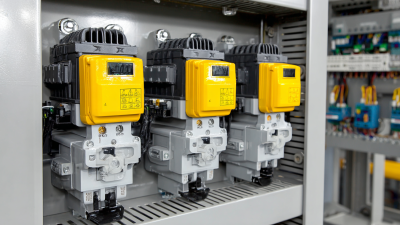
Why Choose the Right Motor Starter for Your Application?
Choosing the right motor starter for your application is crucial. It can impact performance, efficiency, and safety. A motor starter provides the necessary protection and control for electric motors. Selecting the correct one ensures smooth operation and longevity of the machinery.
Different applications require different types of motor starters. Some will handle larger voltage and current, while others may be designed for simple on-and-off operations. Understanding these differences is key. The wrong selection can lead to equipment damage, downtime, or safety hazards.
Professional knowledge in this area is essential. Consider consulting with experts to better understand your specific needs. It’s not just about cost. A reliable motor starter can save money in the long run by preventing failures. Experience shows that informed choices lead to better outcomes.
Understanding Motor Starters and Their Role in Applications
Motor starters play a crucial role in controlling electric motors. They provide the necessary mechanisms to start and stop a motor safely. Understanding how motor starters function can enhance the performance of industrial applications. They serve to protect motors from overloads and short circuits, which can be costly for businesses.
Choosing the wrong starter can lead to operational issues. For example, inadequate protection may cause equipment damage. Furthermore, improper sizing might lead to inefficiencies. Motor starters come in various types, such as direct-on-line, star-delta, and soft starters. Each type has its unique application and benefits. Evaluating the specific needs of your motor system is essential.
The installation of a motor starter should meet local electrical codes. Regular maintenance is also vital for optimal function. Without proper care, starters may fail, resulting in downtime. Understanding the nuances of motor starters can be complex. However, investing time in this knowledge can lead to better decision-making for any application.
Types of Motor Starters and Their Unique Features
Choosing the right motor starter is crucial for your application. Each type of motor starter offers unique features that impact performance and energy efficiency. Understanding these types can help in making informed decisions.
Direct-on-line (DOL) starters are the simplest. They provide full voltage to the motor at startup. This is effective for small motors. However, a sudden start can cause stress on mechanical components. Soft starters offer a gradual ramp-up. They are ideal for larger motors as they reduce inrush current. This feature protects the motor and extends its lifespan.
Tips: Evaluate your motor size and system requirements. This can prevent oversizing or undersizing the starter. Consider future expansion needs when selecting a type.
Starters with overload protection are essential. They prevent damage from excessive current. Thermal overload relays are common but can be unreliable. Electronic overloads might offer better protection. Keep in mind the environment too. Dusty or humid locations can affect starter reliability.
Lastly, consider integrate control features. This can enhance automation and monitoring. Focusing on these aspects helps in choosing the most suitable motor starter. Reflect on your actual needs and revisit choices periodically.
Factors to Consider When Selecting a Motor Starter
Choosing the right motor starter is crucial. It directly affects the efficiency and safety of your motor system. Several factors play a role in this decision. Understanding these aspects can lead to better choices.
One key factor is the motor's full-load current rating. A starter must handle this current safely. If the starter is undersized, it may lead to overheating. Alternatively, an oversized starter can result in energy waste. It is essential to assess your motor’s specifications carefully.
Another crucial consideration is the type of load. Inductive loads differ from resistive loads. They may require specific starter types. Overload protection is vital, too. This feature prevents damage when the motor experiences excessive current. Always review the operating environment as well. Harsh conditions may require specialized starters.
**Tips:** Always consult the motor data sheet for accurate ratings. Pay attention to electrical codes relevant to your industry. Remember: an informed choice reduces downtime and enhances reliability. Don't overlook the importance of compatibility with existing systems. An integrative approach can yield better outcomes.
Why Choose the Right Motor Starter for Your Application? - Factors to Consider When Selecting a Motor Starter
| Factor |
Description |
Importance |
| Voltage Rating |
Ensure the starter can handle the voltage of the motor. |
High |
| Current Rating |
The starter must support the motor's full load current. |
High |
| Type of Motor |
Consider the motor type, such as single-phase or three-phase. |
Medium |
| Starting Method |
Assess whether the motor needs direct, star-delta, or soft start. |
High |
| Environmental Conditions |
Evaluate temperature, humidity, and other environmental factors. |
Medium |
| Protection Features |
Look for overload, short-circuit, and protection against the environment. |
High |
| Size and Design |
Ensure it fits in the control panel and is easy to access. |
Medium |
Common Applications for Different Motor Starters
Choosing the right motor starter for your application is crucial. Each type serves distinct needs in various settings. For example, direct-on-line (DOL) starters are widely used in smaller motors. They provide a simple and effective solution for straightforward applications. However, they can also lead to large inrush currents that stress the motor.
Starters equipped with soft start features are ideal for larger motors. These devices gradually increase power and reduce mechanical stress. This gradual approach helps extend equipment lifespan. Nevertheless, users sometimes overlook the complexity of installation and control systems. This can lead to errors.
In many cases, star-delta starters are a viable choice for motors that require high starting torque. They offer a balance between performance and electrical demand. Yet, the added circuitry can be a challenge for novice operators. Addressing these complexities ensures reliable operation and optimal performance. Understanding these various applications helps in making informed decisions.
Benefits of Choosing the Right Motor Starter for Efficiency
Selecting the right motor starter is crucial for maximizing efficiency in industrial operations. According to a report by the International Energy Agency, proper motor control can enhance energy efficiency by up to 30%. This significant improvement stems from better torque management and reduced wear on motors. Using an appropriate starter minimizes the risk of overheating, which can drastically reduce the lifespan of machinery. Heat-related failures account for nearly 50% of motor issues in numerous sectors.
In practical terms, a good motor starter can lead to substantial cost savings. The Department of Energy states that inefficient motor systems waste billions annually. An optimal starter not only improves energy consumption but also boosts overall productivity. It enables smooth motor acceleration, which reduces mechanical stress. Interestingly, some operators still overlook these benefits, often prioritizing initial costs over long-term gains. The choice of starter should also reflect specific load requirements and environmental conditions, yet misalignments often occur.
Investing in the appropriate motor starter is not merely a facet of operational efficiency; it directly impacts overall system reliability and performance. Studies show that up to 40% of unplanned downtime is linked to motor failures. This figure highlights the importance of integrating intelligent motor control systems. Reflecting on one’s current equipment can uncover inefficiencies, warranting a reevaluation of starter selections for optimized operations.