How to Ship a Full Container to Dubai DDP in 2026?
Shipping a full container to Dubai under DDP in 2026 can look simple on a quote sheet: one price, one destination, one delivery promise. The real work sits behind that line. A shipper must confirm the cargo details, container type, origin charges, sea freight, customs-entry arrangements, duties, taxes, and final delivery address. One wrong postcode or an unclear unloading plan can change the cost. Small details matter.
Dubai freight-forwarding consultant Omar Rahman puts the planning principle this way: “A DDP quote is only as dependable as the cargo data, customs plan, and delivery address behind it.” Treat that as a practical rule, not a substitute for written confirmation. Under DDP, the seller generally arranges delivery and bears specified costs and risks up to the named destination, while import clearance requirements still need careful checking with the responsible parties. Get the precise delivery point in writing.
This guide explains how to compare container quotes, prepare commercial and packing documents, track the shipment, and plan for arrival and delivery in Dubai. It also highlights questions to ask before booking: Are duties and taxes included? Who handles clearance? What happens if the truck cannot access the site? Keep the answers on record. A neat quote can still hide assumptions. Even experienced teams can miss a fee or an unloading constraint, so verify the details before the container leaves.
Define Dubai DDP under Incoterms® 2020: seller handles import clearance and charges
Under Incoterms® 2020, DDP means the seller arranges delivery to the named destination in Dubai and handles import clearance. The seller also pays applicable import duties, taxes, and costs required to bring the goods there. The buyer should still provide reasonable information or documents when needed. State the destination precisely, such as a named warehouse, not simply “Dubai.” Under DDP, delivery and risk transfer when the container arrives at that place, ready for unloading. Unloading is generally not the seller’s responsibility unless agreed separately.
For a full container, confirm what the quotation includes: port handling, customs-related charges, inland transport, and any delivery appointment fees. Ask who will act as importer of record and verify that the seller can legally complete import formalities in the UAE. This detail can be overlooked. A low quote may leave costs unclear, especially when storage or delays occur. DDP does not remove the need for accurate invoices, packing details, and a realistic delivery schedule.
Tips: Get the exact named place and a written list of included charges. Confirm unloading arrangements before the container departs. Review the paperwork carefully; one small mismatch can slow clearance.
How to Ship a Full Container to Dubai DDP in 2026? — Define Dubai DDP under Incoterms® 2020: Seller Handles Import Clearance and Charges
Illustrative planning example: one 40-foot container delivered to a named address in Dubai. Amounts are estimates in USD, not a freight quotation or a customs assessment.
| Cost or requirement | Illustrative basis | Estimate (USD) | DDP responsibility and notes |
| Goods value | Assumed commercial invoice value | 20,000.00 | Included here to show an estimated landed total; it is not a transport or customs fee. |
| Origin export handling | Illustrative container handling and export documentation | 450.00 | Seller arranges and pays export clearance and contracted origin services. |
| Ocean freight to Dubai | One 40-foot container; illustrative rate | 2,100.00 | Seller pays carriage to the agreed named place in Dubai. |
| Cargo insurance | Illustrative allowance; DDP does not itself require the seller to buy insurance | 100.00 | Insurance is included in this example as a commercial choice. |
| Dubai destination handling | Illustrative terminal and handling allowance | 850.00 | Seller pays costs required to bring the goods to the agreed delivery point. |
| Illustrative customs value (CIF) | Goods value + ocean freight + insurance: 20,000 + 2,100 + 100 | 22,200.00 | Planning assumption only; customs authorities determine the accepted customs value. |
| Illustrative import customs duty | 5% of assumed CIF value; actual rate depends on goods classification and applicable rules | 1,110.00 | Under DDP, the seller handles import clearance and pays applicable import duty. |
| Illustrative import VAT | 5% of an assumed taxable base of 23,310.00 (CIF value + illustrative duty) | 1,165.50 | Seller pays import VAT under DDP; the taxable base and treatment must be confirmed for the shipment. |
| Import customs clearance service | Illustrative broker service allowance | 250.00 | Seller arranges import clearance and provides required shipment documents. |
| Final delivery within Dubai | Illustrative container trucking allowance to the named place | 750.00 | Seller bears delivery costs and risk until delivery at the agreed named place, ready for unloading. |
| Illustrative DDP landed total | 26,775.50 | Sum of the example line items; actual charges vary by route, cargo, tariff classification, and delivery address. |
Incoterms® 2020 note: DDP means the seller delivers the goods to the named destination, cleared for import, with applicable import duties and taxes paid. Delivery is made on the arriving means of transport, ready for unloading; unloading is generally for the buyer. Specify the precise delivery address in the sales contract. Duty rates, VAT calculations, permit requirements, and local charges depend on the product, customs classification, origin, and current UAE rules. This illustration excludes any unlisted fees, special permits, storage, inspections, demurrage, and unloading costs.
Select FCL capacity: 20-ft containers hold about 33 m³; 40-ft hold about 67 m³
How to Ship a Full Container to Dubai DDP in 2026?
Choosing the right FCL size starts with the cargo’s packed volume, not its loose product measurements. A standard 20-ft container holds about 33 m³, while a 40-ft container holds about 67 m³. Treat these figures as planning estimates. Pallets, protective packaging, and loading gaps reduce usable space. Measure cartons after packing, then calculate their total cubic volume.
A 20-ft container can suit dense or compact cargo, even when its weight is substantial. A 40-ft container offers more room for bulky goods, but it may not be the better choice if the load is heavy. Check the cargo’s weight and dimensions against the carrier’s limits. Measure twice. Small errors add up. Ask your logistics provider to confirm the selected container type and loading plan before booking.
For DDP delivery to Dubai, request a written quote that clearly lists the included services, such as import clearance, duties, taxes, and final delivery. Confirm the delivery address and whether unloading is included; these details can change the cost. Container space is only one part of the decision. I would leave a little room in the plan for packaging changes—easy to overlook, and frustrating to fix at the last minute.
Classify goods by HS code and prepare the invoice, packing list, and bill of lading
How to Ship a Full Container to Dubai DDP in 2026?
For a Dubai-bound full container under DDP, align the HS code, commercial invoice, packing list, and bill of lading before cargo leaves. The World Customs Organization says the Harmonized System is used by more than 200 countries and economies, covering over 98% of world trade. Classification is not a guess: check the product’s material, function, and construction against the applicable tariff schedule. A small description mismatch can trigger questions at clearance. Be precise.
The invoice should show seller and buyer details, currency, item descriptions, quantities, and values. The packing list should match those quantities and identify carton counts, weights, and dimensions. Check totals against the bill of lading, including shipper, consignee, container number, and cargo description. UNCTAD’s Review of Maritime Transport 2024 notes that shipping carries over 80% of global trade by volume, making consistent paperwork essential across handoffs. DDP also places import-clearance and applicable duty and tax responsibilities on the seller under the agreed Incoterms® rule. Confirm who can complete those steps in the UAE before quoting the landed price; this detail is easy to overlook.
Estimate UAE import costs: customs duty is typically 5%, and VAT is 5%
How to Ship a Full Container to Dubai DDP in 2026?
For a full container delivered to Dubai under DDP terms, budget for import duty and VAT alongside freight, clearance, and local delivery. UAE customs duty is typically 5% of the customs value, though the rate can vary by goods and applicable rules. Import VAT is generally 5%. It is not always calculated on the goods’ invoice price alone.
For a rough example, assume the customs value is AED 75,000 and the duty rate is 5%. Duty would be AED 3,750. If VAT applies to AED 78,750, including that duty, VAT would be AED 3,937.50. This is only an estimate. Customs valuation, product classification, origin, and current procedures can change the final assessment. A small detail can shift the numbers.
DDP means the seller arranges delivery and covers agreed import charges, so confirm in writing who will act as importer and handle customs documents. Ask for a line-by-line quotation showing duty, VAT, port handling, clearance, and final delivery. Some costs are easy to overlook. A quote that says “tax included” without a tax basis deserves a closer look. Check current requirements before booking, since a neat estimate is not a customs ruling.
How to Ship a Full Container to Dubai DDP in 2026?
Illustrative estimate for goods valued at $10,000 with $1,500 freight and insurance: customs duty is estimated at 5% of the $11,500 customs value, and VAT at 5% of the customs value plus duty. The estimated subtotal is $12,678.75, before other charges such as port handling, clearance, delivery, or product-specific fees. Actual DDP costs depend on the shipment and applicable UAE rules.
Ship via Jebel Ali and coordinate customs release, final delivery, and receipt
A full-container DDP shipment to Dubai needs more than a vessel booking. Before loading, confirm the consignee’s legal details, cargo description, tariff classification, declared value, and country of origin. Make sure the commercial invoice and packing list match the goods inside the container. Small discrepancies can delay customs review. They are easy to miss.
At Jebel Ali, the shipment must clear import customs before it can move to its final delivery address. Under DDP, the seller generally arranges import clearance and covers applicable duties and taxes, but the parties should confirm who can act as importer and what local documentation is required. Check these details before dispatch, not after the container reaches port. Port handling, inspections, and release timing can vary. Allow a practical buffer.
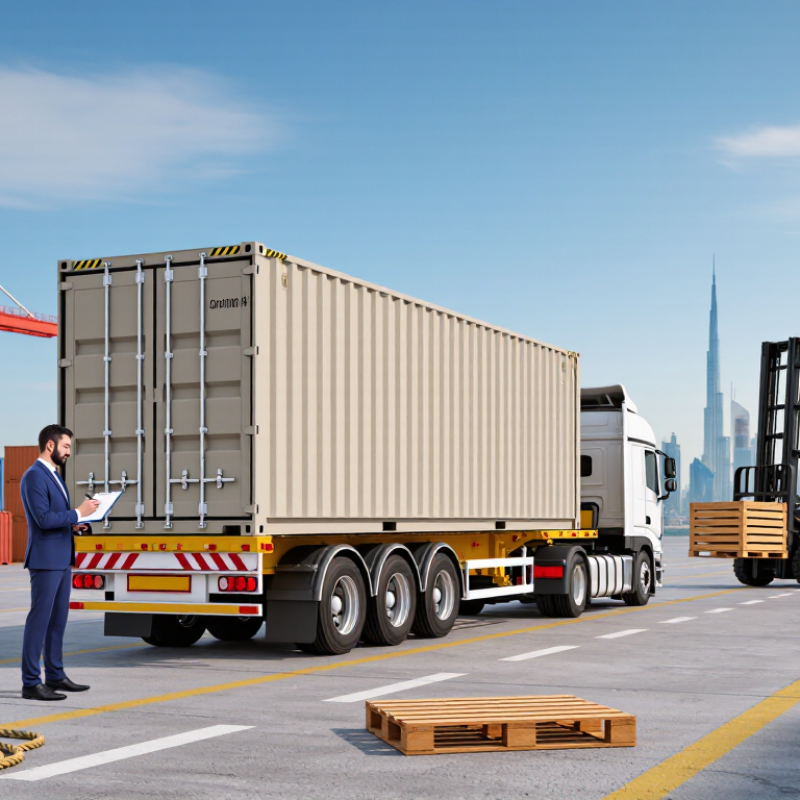
Once customs release is confirmed, coordinate the truck appointment, delivery access, and unloading arrangements with the receiver. Check whether the site has space for a full container and suitable equipment. Keep the release notice, delivery order, and signed proof of receipt together. Note visible damage or shortages immediately, with photographs where appropriate. The paperwork matters. In practice, handoffs can still be messy; a clear contact person and a quick receipt check help expose problems while the delivery details are fresh.