Choosing the right electric motors for your business can feel overwhelming. With so many options available, you need expert advice to make a wise decision. Renowned electric motors specialist, Dr. Alice Thompson, once said, "Selecting the right motor can make or break your operational efficiency." Her words highlight the importance of informed choices in this industry.
Electric motors serve as critical components in various applications, from manufacturing to transportation. They impact performance, energy consumption, and overall productivity. Understanding your specific needs is essential. Factors such as load requirements, speed, and energy efficiency play key roles in selection. Ignoring these considerations may lead to costly mistakes that affect your bottom line.
As businesses increasingly look for sustainable solutions, the choice of electric motors has become more complex. The landscape is constantly evolving. You may encounter brands and technologies that promise remarkable efficiency. However, not all claims are reliable. Conduct thorough research and consult experts to ensure your business thrives while meeting environmental standards.

When selecting electric motors for your business, understanding specific requirements is crucial. Begin by assessing the application type. Are the motors for conveyance, packaging, or machinery? Each application demands different motor specifications, like torque and speed. A motor suited for one purpose may underperform in another.
Consider your operational environment as well. Will the motor operate in extreme temperatures or dusty settings? These factors dictate the design and protection features of the motor. Additionally, energy efficiency plays a key role. Choose motors that meet your energy-saving goals. An efficient motor can significantly reduce long-term operational costs.
Do not overlook regulatory compliance. Ensure your chosen motors meet industry standards. Failing to comply can result in expensive penalties and delays. Lastly, think about scalability. As your business grows, your needs will change. Select motors that can adapt to future demands. This foresight saves time and money during upgrades.
| Tip Number | Tip Description | Considerations | Application Examples |
|---|---|---|---|
| 1 | Identify Your Power Requirements | Voltage, amperage, and phase | Conveyor systems, pumps |
| 2 | Understand the Duty Cycle | Continuous vs. intermittent operation | Industrial machinery |
| 3 | Select the Right Motor Type | AC vs. DC or stepper motors | Robotic arms, fans |
| 4 | Consider Environmental Conditions | Temperature, humidity, and exposure to elements | Outdoor equipment |
| 5 | Evaluate Motor Efficiency | Energy savings and operating costs | HVAC systems |
| 6 | Check for Noise Levels | Decibel ratings | Office equipment |
| 7 | Assess Performance Needs | Speed and torque requirements | Automotive production lines |
| 8 | Consider Size and Weight | Physical dimensions and form factor | Space-restricted applications |
| 9 | Analyze Maintenance Requirements | Ease of upkeep and service intervals | Heavy machinery |
| 10 | Seek Expert Consultation | Professional advice and recommendations | System integration projects |
When evaluating different types of electric motors for your business, it's essential to understand your specific application needs. Different motors excel in various operational settings, ranging from small tasks to heavy-duty applications. For instance, AC motors are often preferred for simple and continuous operations, while DC motors provide better control for precise applications.
Consider the efficiency rating of each motor type. High-efficiency models can lead to significant energy savings over time. However, the initial cost might be higher, prompting a careful calculation of return on investment. Examine torque and speed requirements as well. It's not just about power but how that power translates into productivity.
Installation and maintenance also play crucial roles in your decision-making process. Some motors require specialized knowledge for setup and upkeep, adding complexity. Regular checks are necessary. If maintenance is neglected, efficiency decreases, leading to potential downtimes. Reflect on these aspects to ensure you choose a motor that aligns with your operational goals and capabilities.
When selecting electric motors for your business, understanding key specifications is crucial. Motor efficiency, torque, and power ratings are fundamental parameters. According to an industry report by the International Energy Agency (IEA), electric motors account for approximately 45% of global energy consumption in industrial applications. Thus, choosing a highly efficient motor not only reduces operational costs but also aligns with sustainability goals.
Choosing the right torque for your application is critical. Insufficient torque can lead to performance failures. A study from the Electric Power Research Institute indicates that optimizing torque can improve machinery lifespan. Evaluate the torque requirements based on your specific processes. This ensures that operations run smoothly, avoiding costly downtimes.
Consider the motor's speed range as well. A motor with an adjustable speed feature offers versatility. This is essential in industries with varying operational demands. You might face challenges with fixed-speed motors, as they can limit production flexibility. Identifying the specific needs for your application will guide your choice effectively. The right motor leads to better performance and energy savings in the long run.
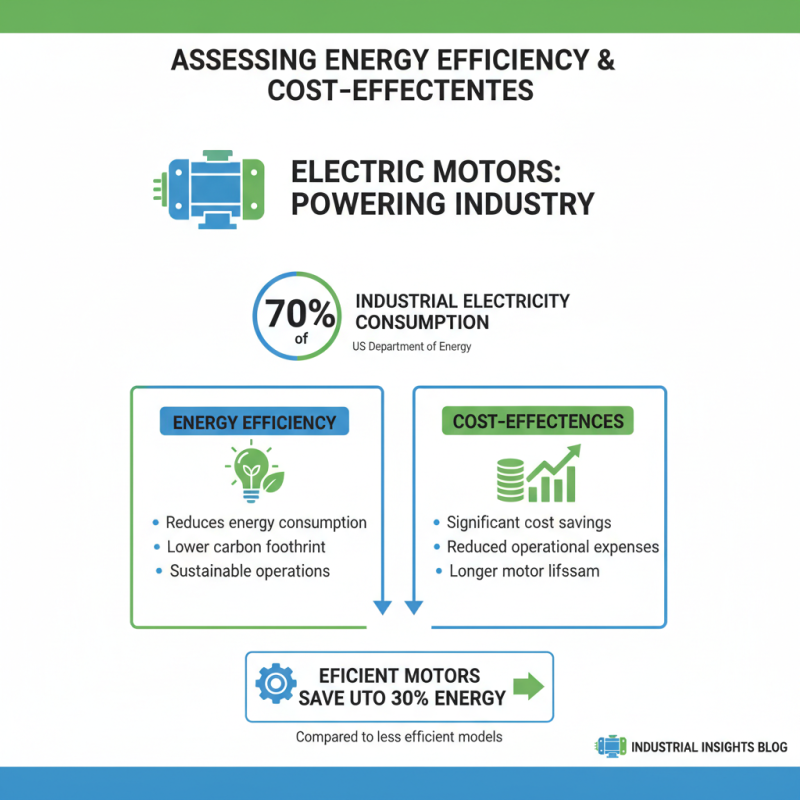
When selecting electric motors, energy efficiency and cost-effectiveness are paramount. According to the U.S. Department of Energy, electric motors account for nearly 70% of industrial electricity consumption. This statistic highlights the importance of choosing the right motor. An efficient motor can significantly reduce energy costs and operational expenses. A well-designed motor may save up to 30% in energy consumption compared to less efficient models.
Cost-effectiveness extends beyond initial purchase price. The life cycle cost analysis (LCCA) reveals a motor's total cost over its service life. This includes energy consumption, maintenance, and potential downtime. The U.S. Environmental Protection Agency estimates that improving motor efficiency could lead to savings of $1 billion annually for U.S. industry. However, many businesses overlook these factors. As a result, they may experience higher operational costs due to inefficient motors.
Understanding the specific efficiency ratings of motors is crucial. Many motors fall into the premium efficiency category, which promises lower energy usage. It's important to note, though, that the initial cost of high-efficiency motors can be higher. Some companies resist these investments because of immediate budget constraints. They may not realize the long-term savings potential. Evaluating the upfront versus operational costs can reveal hidden savings.
Choosing the right electric motor for your business can be challenging. Compatibility with existing systems is crucial. Many factors come into play, such as voltage, speed, and control methods. Understanding your current setup is essential. It helps in avoiding costly modifications and downtime. You can streamline integration by selecting motors that align with your existing equipment.
Next, consider the physical dimensions and mounting configurations. Space constraints may limit your options. A motor that fits poorly can cause issues or inefficiencies. Evaluate how the motor interacts with current components. Verification of all connections is vital to ensure smooth operation. Potential mismatches can lead to performance issues, so thorough checks are necessary.
Finally, think about the long-term implications of your choice. Upgrading systems can be beneficial, yet they require time and investment. Some businesses overlook how new technologies might affect compatibility. Regular reviews and assessments are wise. They help you remain adaptable to future changes in your operational needs. Balancing immediate compatibility with future-proofing can be difficult, but it's necessary for lasting efficiency.